Unofficial Ceasefires


The very unofficial Christmas truces early in the war along sections of the front line trenches during which both sides enjoyed their adversaries Christmas carols and even exchanged gifts were, unfortunately, too short. Once discovered by higher ranking officers at the rear, orders were issued to stop the peaceful activities and return to the business of war in the trenches. And, too often, those orders were very forcibly enforced.


ceasefireGerman - French ceasefire due to flooding. In the background are the French.

Photo by Ober Lieutenant Flaischlen


But unofficial ceasefires also occurred at other times for other reasons. "On 16 December, 1916 there was something different to experience," wrote Ober Lieutenant Flaischlen with the Wurttembergische Reserve Infanterie Regiment Nr. 120 at Verdun.

"It rains. It rains not a normal rain but it goes on and on. And when the rain momentarily stops we have in between snow. The dirt become bottomless and the trenches become stream beds. By the French it is even worse because their positions are lower. Here stand the men opposite each other during the ceasefire. Men bail water, build drainage ditches and take advantage of the situation."


The German Offensive in the Argonne June, 1915


by Major Eduard Zimmerle, Wuerttembergische 49th Feld Artillerie Regiment

Anonymous

French trenches captured by the Germans during the attack.


On June 30 at 5:15 AM the bombardment of the French positions began. Our infantry in the front lines had been pulled back and so it was possible to take the enemy under fire without our own infantry being endangered by any shells falling short. At first the Grenadier Regiment No. 123 fired on the positions with a light field howitzer battery, a heavy field howitzer battery and a 21 cm. Morter battery along with a railroad field cannon and light, medium and heavy Minenwerfern. Soon the valley was filled with smoke and the enemy positions could no longer be seen. The French were generally overwhelmed and those not under the rubble retreated or surrendered. From individual dugouts there was resistance. Our munition handlers were shot at from a telephone hut. One Grenadier calmly cleaned it out with a hand grenade and when he was shot at from another dugout he captured the two Frenchmen at the point of his bayonet. The attitude of our men was excellent and the urge to move forwards conquered what we had earlier believed could only be captured piecemeal.


Gallipoli 1914 - 1915


AnonymousThroughout the invasion, Allied forces were supplied with food, water, ammunition and other supplies carried and hoisted off the supply ships moored as close to shore as possible. Among the support vessels was the Australian submarine AE2. In the hot days, it was tedious, tiring, never ending work as this young soldier's face seems to show.


The Action Near Anzac Cove.

by John Masefield


On August 5th, the Australian brigade told of the attack, sharpened bayonets, and prepared their distinguishing marks of white bands for the left arms and white patches for the backs of the right shoulders. In the afternoon of the 6th, the shelling of the ships became more intense; at half past four it quickened to a very heavy fire; at half past five it stopped suddenly. The three whistle blasts sounded and were taken up along the line, our men cleared the parapet in two waves on a front about one hundred and sixty yards "and attacked with vigour."

Shell Fire

They had not gone twenty yards before all that dark and blazing hill-top was filled with explosion and flying missiles from every enemy gun. One speaks of a hail of bullets, but no hail is like fire, no hail is a form of death crying alound a note of death, no hail screams as it strikes a stone or stops a strong man in his stride. Across that kind of hail the Australians charged on Lone Pine. It was a grim kind of steeplechase, said one, but we meant to get to Koja Dere."


Action at Ypres July, 1916

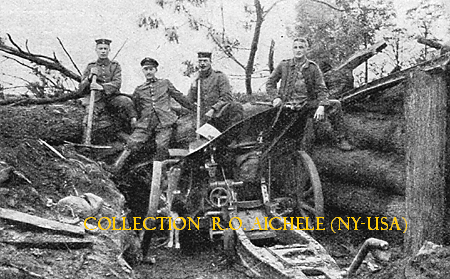
AnonymousKanoniers of the Wuerttembergische 49th Feld Artillerie Regiment's Batterie Scheerer digging out a gun after the firing position was hit by heavy caliber English artillery fire on July 14.


British Somme Offensive

The British Assault on July 1, 1916 at La Boisselle

by John Masefield

Anonymous "In the early morning of the 1st of July, 1916, our men looked at the German positions as they showed among the bursts of our shells. Those familiar heaps, the lines, were then in a smoke of dust full of flying clods and shards and gleams of fire. Our men felt that now, in a few minutes, they would see the enemy and know what lay beyond his parapets and probe the heart of that mystery. So, for the last half hour, they watched and held themselves ready, while the screaming of the shells grew wilder and the roars of the bursts quickened into a drumming. Then as the time drew near, they looked a last look at that unknown country, now almost blotted in the fog of war, and saw the flash of our shells breaking a little further off as the gunners lifted and knew the moment had come. Then for one wild confused moment they knew that they were running toward that unknown land, which they could still see in the dust ahead. For a moment, they saw the parapet with the wire in front of it, and began, as they ran, to pick a path through that wire. Then, too often, to many of them, the grass that they were crossing flew up in shards and sods and gleams of fire from the enemy shells, and those runners never reached the wire, but saw, perhaps, a flash, and the earth rushing nearer, and the grasses against the sky, and then saw nothing more at all, for ever and for ever and for ever."


Action Date: May 27, 1917

Major Eduard Zimmerle, Wuerttembergische 49th Feld Artillerie Regiment

"In the area of the Command Post North, a wounded English flier made a forced landing. The German flier who shot him down, landed next to him and provided the badly wounded adversary first aid assistance."


The Meuse-Argonne Offensive 1918

by Colonel James F. Barber, 304th Engineers, 79th Division, US Army

At 2:30 in the morning of October 4, the regiment was awakened to advance toward Nantillois, and when they were about to leave it was learned that the artillery was going to put over a barrage to assist the advancing "doughboys." After this was over, the regiment moved forward, some of the companies without any breakfast. It developed that the infantry did not advance as far as expected but had encountered very determined resistance. Also the shelling of the roads north of Montfaucon was very severe, and the town of Nantillois, through which the "doughboys" had passed was peppered off and on frequently during the day. Therefore, the First Battalion which was in the rear of the column returned to Montfaucon shortly before noon.

The Second Battalion, however, continued the advance moving very cautiously and slowly on account of the heavy shelling. A picked squad of Co. "D" under Lieut. Covell, reconnoitered the Cierges-Nantillois road as far as Nantillois. The battalion was held up just south of the town all the forenoon, as all manner of projectiles were being rained down into the valley.


With The American 28th Division - - 110th Infantry - July 28, 1918

Anonymous

A street in Fresnes after the fighting.


During the morning, regimental headquarters at Fresnes were blown up, Lieutenant Colonel Fetzer and several orderlies being killed. During the afternoon, the Second Battalion joined the Third at the foot of the hill north of the river, and on the morning of the next day the Third stormed Hill 230 but was held up by heavy artillery and machine gun fire. At the same time the Second Batallion moved toward Grimpettes Woods, with Companies E and G leading. While the edge of the woods was reached, the casualties were so heavy crossing the open stretch in full view of the enemy, that it was necessary for the survivors to fall back to their original positions. Companies E, G, I and K suffered severe casualties in the first part of this attack. Those of K were the most severe, the ranks of that company raked by deadly machine gun fire as they stormed the slope and forty-one men were killed. Campany E penetrated the woods the farthest before the ridge was finally carried.


The Lost Battalion

by L.C. McCollum, 1st Battalion, 77th Division, US Army


"The first 'trap' or 'pocket' in which we were caught came about as a result of the 92nd Division retiring a distance of from two to three kilometers after encountering stiff resistance from the Germans on September 28th. This left a large gap on our side flank, which they had formerly occupied, and the Germans immediately took advantage of this and closed in on us cutting us off before we realized the that the 92nd had fallen back. We were in that trap September 28th, 29th and 30th and were reunited with the rest of the division on October 1st. One the night of October 2nd the battalion was again caught in another trap, which lasted for a period of six days and six nights....

During the day of October 2nd, Company A was badly cut up while taking a small hill, and during the attack we lost 90 men in less than 30 minutes fighting. About 40 members of the company were sent back by Major Whittlesey to establish posts of communications and to act as stretcher bearers, as men were being wounded faster than they could be handled. Eighteen of the company remained with the Major and were caught in the second trap.

We fought desperately during those six days going "over the Top' as often as three times in one day. That you may have some idea of the cost of the ground taken in those Argonne Woods, can give you the facts of my own company of which I have an intimate knowledge. We went Over the Top on September 26th with 250 men and on the night of October 15 there were only 44 of us followed Major Whittlesey out of the front lines to the second lines of support near Grand Pre."


The following is from an account by Private Lowell R. Hollingshead, 18 years old and part of Major Whittlesey's battalion, after having been pinned down by German machine gun fire on October 7, 1918:

"I was afraid to move for fear the Germans would start their murderous fire again but just about that time a German appeared from behind a bush not six feet from me and held a long Luger revolver leveled at my head. It is an actual fact that the barrel of it looked to me at that time as large as a shot gun.

The German half smiled, half sneered and I instinctively raised my hands and said the only German word I knew, 'Kamerad.' Perhaps a second passed between the time I said Kamerad until he slowly lowered his gun, but it seemed like several lifetimes to me... After the German lowered his gun he smiled a great big smile and what a lovely looking German he was. As he stood there in his gray uniform fully six feet tall, his smile seemed to broaden and broaden then he started walking toward me. I suppose the reason his smile is still in my mind is because it was so unexpected, as I had been taught to hate and expect fearful things from the Germans should they ever capture me. I do not honestly believe there was ever any real hatred in my heart for the Germans or anyone else, and I have yet to hear any man who was actually IN IT say he ever had hatred in his heart...

The German stepped over to me and started talking in his own language and pointed at my leg. I half turned and looked to where he was pointing and saw blood spurting out from my leg near the knee. For the first time I realized I had been hit. Then other Germans appeared and began looking at my comrades and then I knew how they had fared. Of my seven Buddies I found four had been killed outright and all the rest wounded. Our Indian guide was one of those who had been killed.

My three comrades were more seriously injured than I and the same German who captured me put my arm around his shoulder and I half hobbled and was half carried over to where the machine gun sat which had played such havoc with us. The other Germans carried my comrades over...By this time a German Runner returned and motioned for me to get up and started walking back through the forest with me, while other Germans carried my three comrades on improvised stretchers. After we had gone a short distance I was turned over to another guide and a little father on another, and in this way I was relayed back to German headquarters."


U.S. 77th Division on the Northern Bank of the Aire

The 153d Brigade was awarded a commendation by Major-General Robert Alexander, commanding the 77th Divison, for the capture of St. Juvin on October 14, 1918, "after a difficult night march the attack was made and the objective set for the day's effort successfully reach. In the course of the operations a large number of prisoners, including officers of superior rank, were taken by the 153d Brigade."

The Divsion History noted, "The enemy had not yielded St. Juvin, however. On the night of the 14th, no less than six barrages were poured into St. Juvin and the valley south of the village and continuous harassing fire of artillery, trench mortars and machine guns swept the positions of our troops in the vicinity of the town. A great deal of the enemy's fire fell on our rear lines and caught the divisional reserve in the valley at La Besogne, inflicting twenty-five casualties among the machine gunners of the divisional machine-gun battalion, held in reserve at that point. In the morning over came a counter attack. A severe fight ensued but St. Juvin stayed in our hands.

The 308th threw one battalion across the Aire to the east of Grand-Pre, with its right resting at La Kairesse and its left at Chevieres. The mission of this force was to move by the left and cut the enemy's communications in the east. Meanwhile the main attack against Grand-Pre was preparing."

Anonymous


The objective: Grand-Pre


American Troops at Montfaucon October, 1918

by Colonel J. F. Barber, 304th Engineers, 79th Division, USA. October, 1918


Anonymous

American troops entering the former German stronghold of Montfaucon.


"That night a platoon of Co. E was ordered to move ahead to remove a wrecked tank that was obstructing the road north of Montfaucon. This tank had been disabled in the middle of the road, and could not be operated. It had to be dragged, persuaded, or in some way cajoled by boards, levers and what-not into an inoffensive place off the road. The work on it had to be performed in the dark as quietly as possible, as it was exposed to enemy fire and quite near the front lines. The first night the platoon moved it a little bit, before the enemy was aroused and prohibited further activity with his "whiz-bangs." The next night is was moved a little more when the "G.I. cans" came hurtling through the air The following morning when the regiment advanced toward Nantillois, another platoon of Co. E removed it altogether."


The Crown Prince's Observation Post After Capture by the U.S. 79th Division.


Report of the 304th Engineers, 79th Division, USA


Anonymous

The Chateau Viewed From The East.


The Crown Prince is reputed to have used this place in Montfaucon as his headquarters during the battles of Verdun. The Germans built it with characteristic thoroughness which could survive any ordinary bombardment. In fact, it has survived both our own and German fire during the September 1918 drive to the Argonne.

The chateau is a 3 story barn shaped building, constructed with the massive outside and inside masonary walls, common to the older French architecture. The Germans have first laid a heavy course of reinforcing over the first floor, making the arched cellars excellent shelters with from 6 to 10 feet of masony and a 30 inch stone cover. In addition a dugout was built under the road providing an additional 18 feet of cover. From the basement is built a tower reaching to a total height of 35 feet. This tower is well protected, having for the most of its height three feet of concrete and two masonary walls on the side toward the enemy line. A 4 foot slab covered the top. A small chart room at the highest point sheltered the observer and his instruments.

The special feature of the place was a powerful, reflecting telescopic periscope mounted on a gun carriage and put in place on the first floor with the tube running through the tower and out the roof. This instrument was so constructed that observation could be carried either through selective eye pieces at the base of the tube on the first floor, or by means of reflectors and prisms from the second or third floors. A large and very elaborate observation map was found mounted in the chart room scaled in mils and orientated with respect to the instrument, so that to lay on any point on the map it was only necessary to get its mils defelection from the map, turn it off on the traversing scale of the telescope and bring it into focus from the eye piece.

The instrument was captured in servicable condition, but before it could be brought to bear on the enemy lines, some thoughtless souvenier hunter stole the eye pieces rendering it useless.


Links To Other World War I Sites:


Liege - The Overturebelgians


Other Information Works Links

Information Works inc.


Other Information Works' Great War Sites

The Great War At Sea

Return to the Western Front - 50 Years Later


Peacetime Sites

At Sea - The Great and Near Great Ships

Vessels On America's Inland Waters

America's Railroad Heritage


Last update 03/29/2008.

Copyright 2008. All rights reserved by Information Works inc.,

P.O. Box 4725, Saratoga Springs, NY 12866 USA

Author: Richard O. Aichele